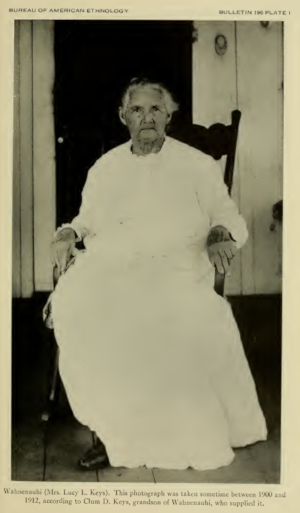
Wahnenauhi, or Lucy Lowery Hoyt Keys, lived in Oklahoma during the 1800's. She was a member of what Cherokee author Jack Frederick Kilpatrick termed the "planter class of mixed bloods--wealthy, educated, and receptive to all the Victorian attitudes of the corresponding stratum in Southern White society." This was a time when Wahnenauhi's social class vigorously promoted Cherokee acculturation into white society, and most traditional culture went underground. Despite this prevailing attitude among her peers, she wrote a manuscript on Cherokee history and customs, titled Historical Sketches Of The Cherokees, Together With Some Of Their Customs, Traditions, And Superstitions that was published in 1889 in the Bureau of American Ethnology's 196th Report. James Mooney made extensive use of Wahnenauhi's manuscript in preparing Myths, History, and Sacred Formulas of the Cherokees, an important source of information on traditional Cherokee culture.
In Jack Frederick Kilpatrick's introdution to Wahnenauhi's manuscript he describes the myths she recounts as having "the ring of authenticity of the family fireside of her grandparents." Her maternal grandfather was Major George Lowery, a Cherokee leader who was part of a delegation that visited George Washington in 1792-1792, collaborated on the first Cherokee translation of the New Testament, and was assistant principal chief in 1828. In Wahnenauhi's letter to the Bureau of Ethnology she said she was at Major Lowery's house "when George Guess (Sequoyah) left for the West, also when his companions returned without him." Kilpatrick describes her information on Sequoyah as "not extensive, but nevertheless priceless."
Kilpatrick found Wahnenauhi's manuscript intriguing because, as he puts it, her language is "replete with young. ladies finishing school posturing. The spirit of Scott and Tennyson pervades her pages", while "a scant few miles from her desk her tribesmen were "going to the water" with the same frequency, the same earnestness, and for the same purposes as they did in prehistoric times."
Mary Ulmer Chiltoskey, storyteller of "The Legend of the First Woman", was a widely known and respected storyteller who lived with the Eastern Band of Cherokee in North Carolina for 6 decades. In addition to Aunt Mary, A Tell Me Story, she was also author of Cherokee Words With Pictures, co-author of Cherokee Plants: Their Uses - A 400 Year History, and publisher, with her husband Going Back Chiltoskey (a renowned Cherokee wood-carver) of Cherokee Cooklore - To Make My Bread. She taught history and was a librarian in the Cherokee schools and was active in all phases of the Cherokee community. In 1989 she was named an honorary member of the Eastern Band for her many years of service to the Cherokee people. She passed away in October, 2000, at the age of 93.
Books: (The Native History Association is an Amazon Associate. If you buy using one of our Amazon Book links, we get a small percentage of the sale, and we appreciate that support.)