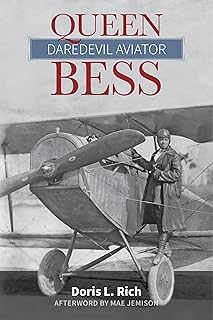
“The air is the only place free from geographical restrictions and national and racial prejudices.” - Bessie Coleman, Aviator
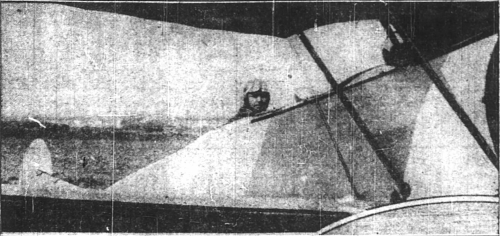
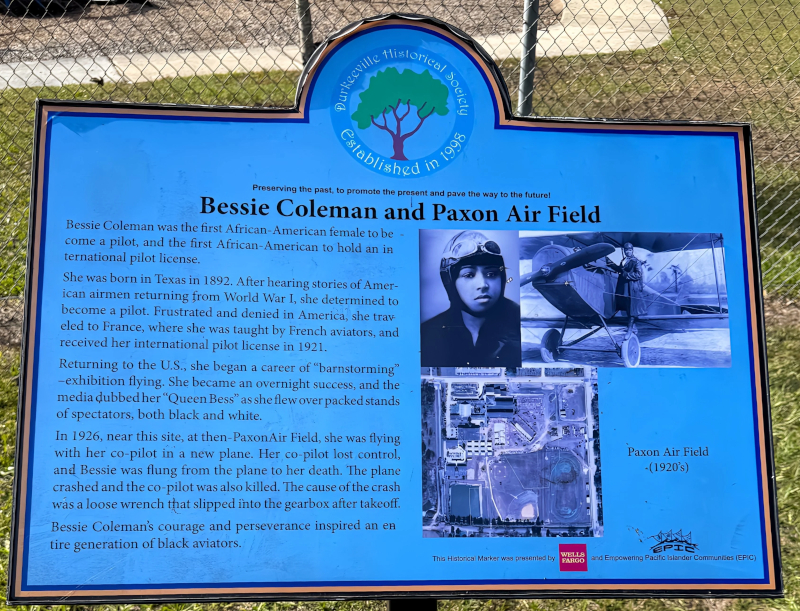
Bessie Coleman was the first African-American woman and first known person with Native ancestry to earn a civilian pilot's license. In the fall of 1919, she was 27 years old and working as a successful manicurist in Chicago when she decided to become an aviator, inspired by the stories of pilots during World War I and teasing from her brother. Unable to find a pilot to teach her to fly in Chicago, she traveled to France in 1920 and attended the École d’Aviation des Frères Caudron flight school. in 1921 she passed the test for an international license from Fédération Aéronautique Internationale (FAI). She returned to the U.S., dreaming of founding an aviation school to train African-American pilots, and became famous while risking her life trying to raise money for the school by performing in dangerous stunt flying exhibitions, and she refused to fly for whites-only events. Her dream of her own school never materialized in her lifetime, and she finally died trying to make it a reality, but her skills and determination inspired generations of future aviators, including the Tuskegee Airmen of World War Two, and Dr. Mae Jemison, the first African-American woman in space.
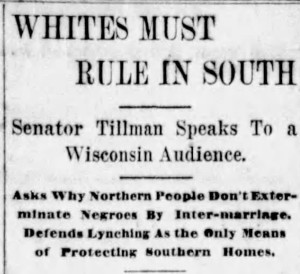
Bessie Coleman was born in 1892 in a dirt-floored cabin in Atlanta, Texas. In 1894 her family moved to Waxahachie, Texas. Her parents were African-American, and her father also had Native ancestry, possibly Cherokee or Choctaw. This was the Jim Crow era, when Southern States passed laws discriminating against African-Americans and many people in the North had racist attitudes. Lynchings were common in the South, and also occurred in the North. In Texas, racism towards Native people was possibly even more intense. In 1901, Coleman's father, George, decided to move to Indian Territory, where his father was from, hoping for a safer environment and more opportunity. Coleman's mother, Susan refused to go and stayed in Waxahachie to raise their children alone.
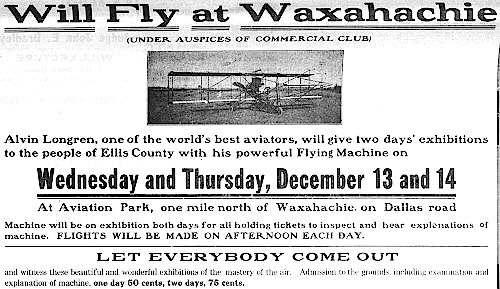
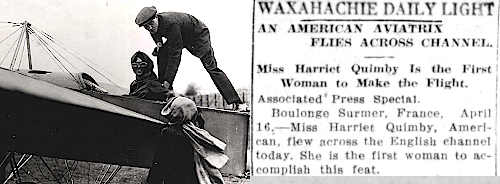
Coleman grew up along with American aviation. She was 11 years old in 1903 when the Wright Brothers made the first powered, heavier-than-air flight. By 1910, when Coleman was 18, three major airshows were held in Los Angeles, Boston and New York, drawing thousands of spectators. In 1911 aircraft designer A.K. Longren gave a one-man flying exhibition in Waxahachie. It's not known if Coleman was part of the large crowd that saw the show, but she probably heard about it, at least, as it was well publicized there. Earlier that year Harriet Quimby became the first American woman to earn a pilot's license, and in 1912 became the first woman to fly across the English Channel.
World War I exploded in Europe in 1914. The U.S. was neutral at first, but hundreds of American pilots enlisted in the British and French air corps. Coleman later said that she became interested in flying during the war after seeing “hundreds of airplanes flying around Texas.” The first commercial flight in the U.S. also took place in Florida in 1914. It was obvious that aviation was going to play a key role in the future.
In 1915 Coleman joined the “Great Migration” of African-Americans from the South to the North and moved to Chicago, where she became a successful manicurist. This would have been an exciting time for anyone interested in flying to be in the city, maybe especially for a woman. Katherine Stinson became the first American woman to do a loop during an exhibition at Cicero Field in 1915, and the following year, Ruth Law broke the long distance sustained flight record in a flight from Chicago to New York State.
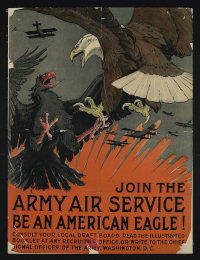
In April, 1917 the U.S entered WWI, and nine days later, Ruth Law, now the “greatest aviatrix”, according to the Chicago Tribune, launched a series of recruiting flights over the Midwest. A week after that a military aviation school opened in Chicago. Over the following months Coleman may again have seen “hundreds of airplanes flying around” the city on training missions. Chicago papers featured hundreds of stories on the war with accounts of the latest aerial battles over the front lines, and quoted military officials calling for the U.S. to develop it's air power and capacity to train pilots.
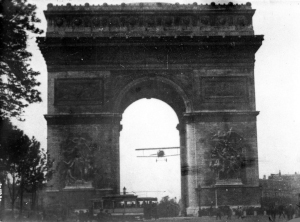
WWI ended in November, 1918. Exhibition flying, banned during the war to conserve aviation resources, was resumed enthusiastically. In April 1919, an air combat reenactment was held in Grant Park in Chicago, and the first non-stop transatlantic flight from Newfoundland to Ireland was made in June. In August, French pilot Charles Godefroy became famous after flying a Nieuport fighter under the Arc de Triomphe in Paris. In the fall a transcontinental air race was held, from New York to San Francisco and back. It was around this time that Coleman finally decided to learn to fly. In the biography Queen Bess: Daredevil Aviator, author Doris L. Rich credits a teasing-sibling conversation with Coleman's brother John, a returned WWI vet, as the final push for her life-changing decision. In front of customers in the barbershop where Coleman worked, John told her “You ain't never goin' to fly”, and she replied “Thats it! You just called it for me.”
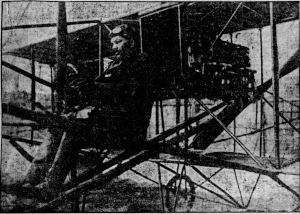
Before Coleman could get her wings, she had to learn how to fly, but local flight schools turned her down, possibly because of her race, her gender, or both. There was an African-American aviator living in Chicago, L.A. Headen, who had learned to fly in 1911 at a flight school in New York. It's not known if Coleman approached him, but she was probably aware of him. He was an inventor and the Chicago papers ran stories about his proposal to build “stealth” devices for ships during WWI. Headen had tried exhibition flying but met resistance from event organizers and gave up barnstorming by 1914. He didn't own a plane, which would have been an obstacle for giving flying lessons, and he ran a successful repair garage and started a car company, so would have been very busy, but it's intriguing to speculate on what advice he would have given Coleman.
Coleman then sought advice from Robert Abbott, the publisher of the Chicago Defender, a newspaper that promoted African-American achievement. Abbot suggested that she go to France where racism was much less prevalent and learn to fly there. Many American fighter pilots were trained in France before the U.S entered WW1, including the first military-licensed African-American fighter pilot, Eugene Bullard (who also had Native ancestry). The Chicago Tribune quoted Ruth Law, the “greatest aviatrix”, as saying “The French know far more about flying than we do. In France an aviator who does only straight flying does not count for anything.” And Harriet Quimby had been licensed in France. Abbott advised Coleman to learn French and save her money, and he would help her find a flight school in France.
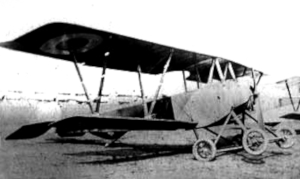
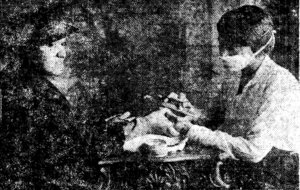
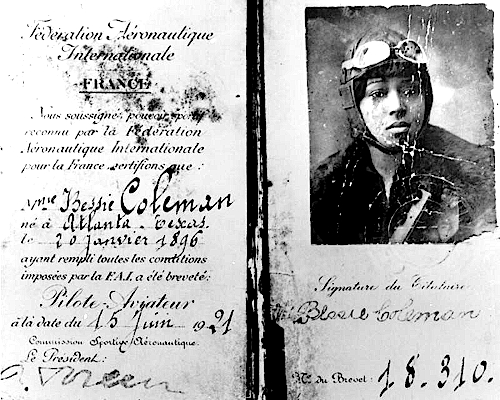
So Coleman took French lessons, got a better paying job, and saved her money. She also got financial support from Abbott and possibly other backers. In November, 1920, 2 months after women won the right to vote in the U.S, she sailed for France. In Le Crotoy, she enrolled in the highly respected École d’Aviation des Frères Caudron flight school, where she learned to fly in a two-seater Nieuport Type 82 trainer, a biplane with a 40 foot wing span and extra wheels in the front to prevent students from tipping over. The instructor sat in the front, the student in the back. After passing the seven month course, Coleman passed the qualifying test from the Fédération Aéronautique Internationale, the same organization that licensed Harriet Quimby, and on June 15, 1921, became the first African-American woman and the first person with Native ancestry to earn a civilian pilot's license.
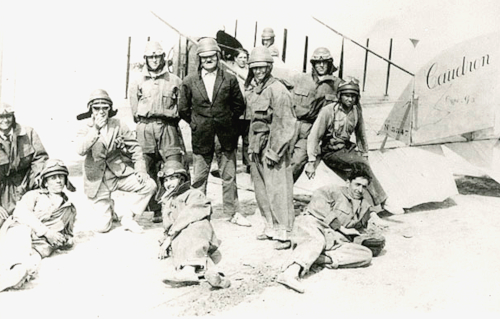
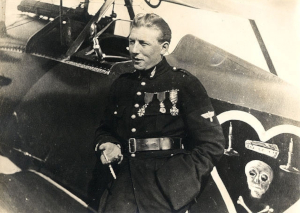
Coleman then went to Paris to take more flying lessons with an instructor she identified only as “an 'ace' fighter pilot who had shot down thirty-one German planes during the world war.” This instructor may have been Charles Nungesser, a highly decorated French pilot. His Legion of Honor citation credits him with “Thirty one enemy planes shot down.” Promotional materials for some of Coleman's later exhibition flights describe her take off as a “Nungesser start … beyond the ability of the average aviator to perform”. For most of Nungesser's combat missions he preferred Nieuport fighters. Coleman trained on a Nieuport and told the press she had ordered one while in France.
Coleman returned to the U.S. in September, 1921. In interviews she expressed an ambition to be an “inspiration for people of her race to take up aviation.” She told the Chicago Defender “We must have aviators if we are to keep up with the times”, and the paper advised anyone desiring information to contact her. Coleman's hope to increase African-American participation in aviation would be a central theme of her flying career.
In February, 1922, Coleman returned to France for more flight instruction. She also went to Holland to visit Anthony Fokker, the well know aircraft designer who built some of Germany's best planes in WWI. She visited Germany, and was filmed by Pathe News flying over the Kaiser's palace. She also took advanced aerobatic instructions from German ace pilot Robert Thelen.

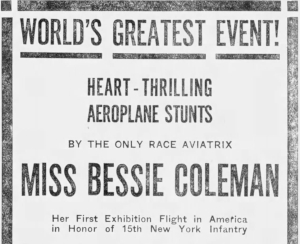
Coleman returned to the U.S. in August, 1922. The Chicago Defender organized an event in New York that would be her first American exhibition flight, featuring “Heart-Thrilling Aeroplane Stunts” on September 3. Her Nieuport plane never arrived, so on the day of the airshow she borrowed a Curtiss JN-4, also known as a “Jenny”, from the nearby Curtiss aircraft company. Coleman had never flown a Jenny, so on the first flight a Curtiss employee piloted the plane with Coleman in the rear seat to check out her skills. On the second flight Coleman finally made her first solo flight in America. It was a relatively simple flight, taking off, doing a figure eight, and then landing. She performed no stunts. According to press reports, the crowd of 1,000 to 3,000 was happy just to see her basically take off and land - it was a historic event, after all. An “immense” passenger plane also gave rides, and according to the Afro-American newspaper “Probably more people of color went up that day than had ever flown since the planes were invented.”
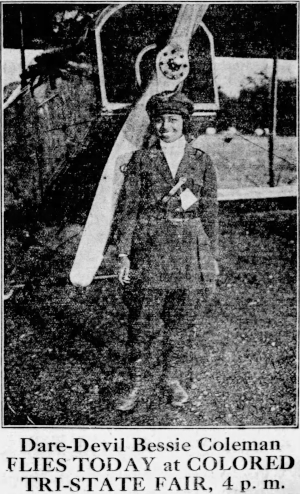
Coleman returned to Chicago in late September, 1922, where, according to the Chicago Whip newspaper, she gave a series of lectures in local churches. Her next exhibition was in Memphis, Tennessee on October 12 at the “Colored Tri-State Fair”. This performance involved some actual stunt flying with tail-spins and flying low at 250 feet. The first day's performance was seen by a crowd of more than 2,000. The second day was a Friday and the schools had a holiday, so an expected 20,000 school children may have seen Coleman fly “with coolness of nerve and ability to handle the plane.”
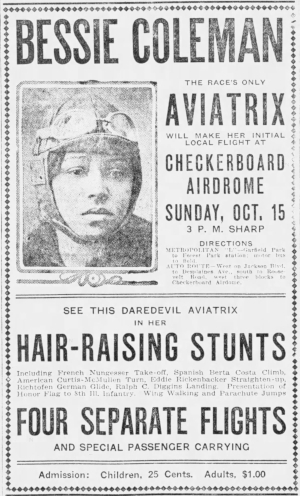
Two days after the Memphis show, a homecoming exhibition was scheduled for Coleman at Checkerboard Aerodrome in Chicago on October 15. An estimated crowd of 2,000 watched as “Queen Bess” took to the air over the Windy City, in a plane borrowed from David Behncke, the owner of the Aerodrome. According to the Chicago Defender the show was “in every way a success”.
Three days after the Chicago show, October 18, 1922, Coleman was scheduled to be in New York to star in a full-length movie for an African-American production company, based on a story by Jesse Shipp, “the dean of Negro directors and producers”. When she learned that the first scene called for her to appear as an "ignorant girl just arriving in New York”, Coleman reportedly said “No Uncle Tom stuff for me” before walking out and breaking her contract.
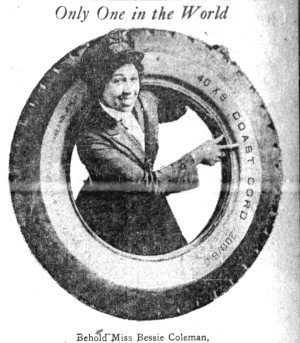
After the Chicago exhibition, Coleman did no other public flying for the rest of the year, but she opened an office in the city and was giving flying lessons, probably borrowing a plane from David Behncke at the Checkerboard Aerodrome. One of her students was Robert P. Sachs, director of advertising for the Coast Tire and Rubber Company in California. Sachs hired Coleman for a west coast advertising campaign, including exhibitions and dropping ad literature from the air.
Coleman traveled to Oakland in January, 1923 and visited the Coast Tire factory, then went to San Diego and bought a surplus Curtiss JN-4 for Sachs at a price of $400. Coleman flew the plane to Long Beach with a group of 3 other pilots who had bought surplus planes, where they arrived after dark and mistook burning gas wells for the lights of Daughtrey airfield. Coleman landed in a plowed field next to the airfield, which then used it's searchlights to guide the other 3 pilots in to safely land.
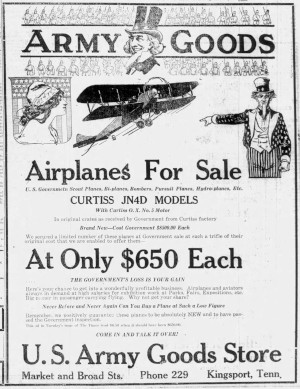
The next day, Coleman flew to Santa Monica and arranged an exhibition flight for February 4 at Palomar Park in Los Angeles. On the day of the Palomar Park show, with 10,000 people waiting to see her fly, Bessie Coleman took off from Santa Monica, but the plane stalled just after leaving the ground, at 300 feet, and nose-dived to the ground. Coleman suffered a broken leg, fractured ribs, multiple cuts, and possible internal injuries. The cause of the crash isn't known, but this type of aircraft accident wasn't uncommon at the time, with planes that had been flying along fine, then suddenly stalling or having control issues and crashing, often with fatal results.
Coleman was in the hospital for 3 months. Sachs wrote a letter published in the California Eagle newspaper asking for donations for her. While still in the hospital she placed an ad for the Coleman School of Aeronautics with a contract specifying $400 as the tuition, but apparently had no takers. After leaving the hospital she did a series of 5 lectures at the Los Angeles YMCA, and returned to Chicago in June, 1923.
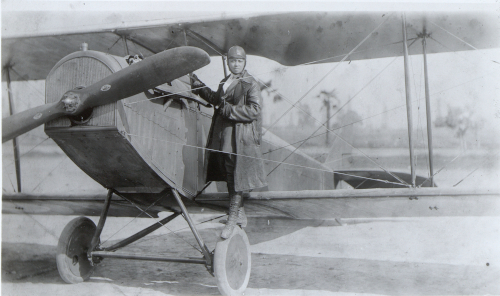
For Labor Day, September 3, 1923, Bessie Coleman was booked to fly an exhibition in Columbus, Ohio. The Labor Day show was rained out, but Coleman returned the following week and flew for a crowd of 10,000 people. This was the last public flying exhibition she would give for almost two years. The hiatus may have been due to Coleman simply wanting a break, but was partially related to management issues.
In February, 1924, D. Ireland Thomas, a theater manager and entertainment columnist for the Chicago Defender, announced that Coleman had signed a contract to appear in theaters with educational films of her flights, under his exclusive management. Coleman used the films in previous lectures and they included the Pathe newsreels of her in Germany, her appearance at the Memphis fair, and a film of her in California, which showed her crash in Santa Monica. These theater appearances were well received during the spring of 1924.
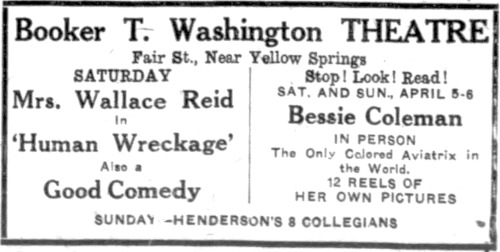
In early May, 1924, the Afro-American and Chicago Defender ran stories alleging that Bessie Coleman had a “long list of incomplete contracts,” and that she was under an investigation. On May 24, the Chicago Defender ran a story headlined “Bessie Banned,” which reported that the Theater Owners Booking Association, an organization that booked acts for theaters with African-American audiences, had issued orders not to book Bessie Coleman because they had received a large number of complaints that she had not fulfilled contracts. It's probably worth noting here that the T.O.B.A had a reputation for being hard on performers. The singer Ma Rainey (subject of the film Ma Rainey's Black Bottom), claimed the acronym actually stood for “Tough On Black Asses”.
A year after being “banned” by the T.O.B.A, Bessie Coleman managed to arrange a lecture in her home state of Texas at the Negro Odd Fellows Hall in Houston, on May 9,1925, followed by a "Flying Circus" exhibition on June 19 – Juneteenth, the anniversary of the day in 1865 that enslaved African-Americans were actually liberated in Texas, over two and a half years after the Emancipation Proclamation. Still not owning a plane, she flew a borrowed Curtiss JN-4 for the Juneteenth show, which was held at the end of Main Street. The event was heavily publicized, even in white newspapers, and included a separate seating area for white people. The Houston Post-Dispatch reported that Coleman “spiraled and looped to the complete satisfaction of the crowd.” A jump by African-American parachutist Ulysses Stalling, stunt flying by other pilots, and passenger flights for the audience were also part of the show.
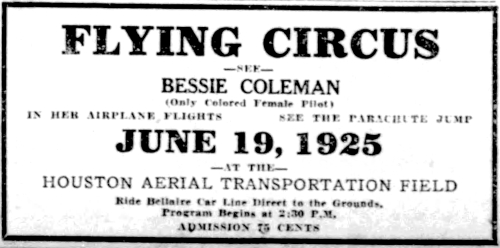
The success of the Juneteenth show led to a series of exhibitions around Texas in Richmond, two more in Houston, San Antonio, Austin, Fort Worth, and others. In San Antonio, the program included the first parachute jump by an African-American woman, Eliza Dilworth. On August 11, Texas Governor Miriam Ferguson received Coleman at the governor's mansion in Austin. Coleman had dedicated her second exhibition in Houston to Ferguson, the state's first female governor and an opponent of the Ku Klux Klan. Coleman also continued to give lectures at movie theaters.
In late August, Coleman went to Love Field in Dallas and made a down payment on a surplus Curtiss JN-4, but she couldn't take possession of the plane until it was paid off. She then gave 2 exhibition flights in Wharton, Texas, on September 5 -6. Another parachute jump by Dilworth was on the program there, but for the first show Dilworth claimed to be ill and refused to jump. Coleman then sent for another pilot from Houston to come to Wharton to fly her plane the next day so she could do the parachute jump herself, which the crowd loved. Coleman's decision to add personal parachute jumps to her routine, almost as an afterthought, would prove to be far more consequential than it probably seemed at the time.

On September 26, 1925, ten years after leaving Waxahachie, the town where she grew up, picked cotton, and may have seen her first flying exhibition, Bessie Coleman returned to give her own successful exhibition at the Trinity Athletic Field.
After Waxahachie, Coleman flew two exhibitions in Fort Worth on Oct. 11, and Oct. 25, 1925, then returned to Chicago. Apparently the ban announced by TOBA a year and a half earlier had been lifted and D. Ireland Thomas booked Coleman on a lecture tour of movie theaters, with some exhibition flights also planned, in South Carolina, Georgia and Florida, starting the first week of 1926. The tour was a success, and the Chicago Defender reported Coleman was “packing them in everywhere she plays.”
In Orlando, Florida, Bessie Coleman met Edwin M. Beeman, heir to the Beeman Chewing Gum fortune. Beeman gave Coleman the money to pay off the plane she had bought in Dallas eight months before, which was still in storage at Love Field, and have it flown to Jacksonville for her next exhibition on May 1, at the Negro Welfare League's annual Field Day event. William Wills, a mechanic and pilot for the Curtiss Southwestern Airplane company, flew the plane to Jacksonville, taking off on April 27. Coleman took a train from Orlando to Jacksonville the same day. Wills arrived in Jacksonville on April 28 after having to make two unscheduled stops because of engine trouble.
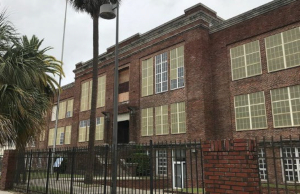
On April 29, 1926, Bessie Coleman spoke at the three African-American schools in Jacksonville during the day, and gave a lecture at the Strand Theater that night. The next morning, April 30, Coleman, and John Betsch, publicist for the Negro Welfare League, arrived at Paxon Field around 7:30 am. Wills and Coleman planned to take the plane up so she could scout out a landing spot for her parachute jump the next day. They took off with Wills flying in the forward cockpit, while Coleman rode in the rear cockpit, not strapped in so she could see over the sides of the plane. They circled the location where the jump was to be held and headed back to the field.
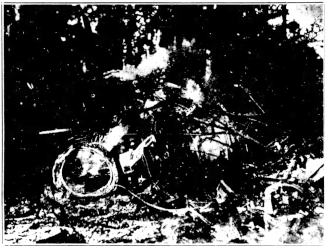
As it approached Paxon Field, witnesses on the ground said the plane suddenly nose-dived, then went into a tail-spin at 1,000 feet. At 500 feet it flipped over, flying bottom up. Bessie Coleman fell out and plummeted to the ground, landing in an area near present day Hammond Park, and was killed instantly. Wills continued trying to regain control of the plane, but nearing the ground it hit a pine tree and crashed to the ground, killing Wills. Two pilots from Paxon Field, along with John Betsch rushed to the plane but there was nothing they could do. Three police officers arrived and started to remove Wills body, but Betsch, who was badly shaken, lit a cigarette and the match ignited the highly flammable aviation fuel. The plane erupted in flames, forcing the officers back, and three more explosions followed.
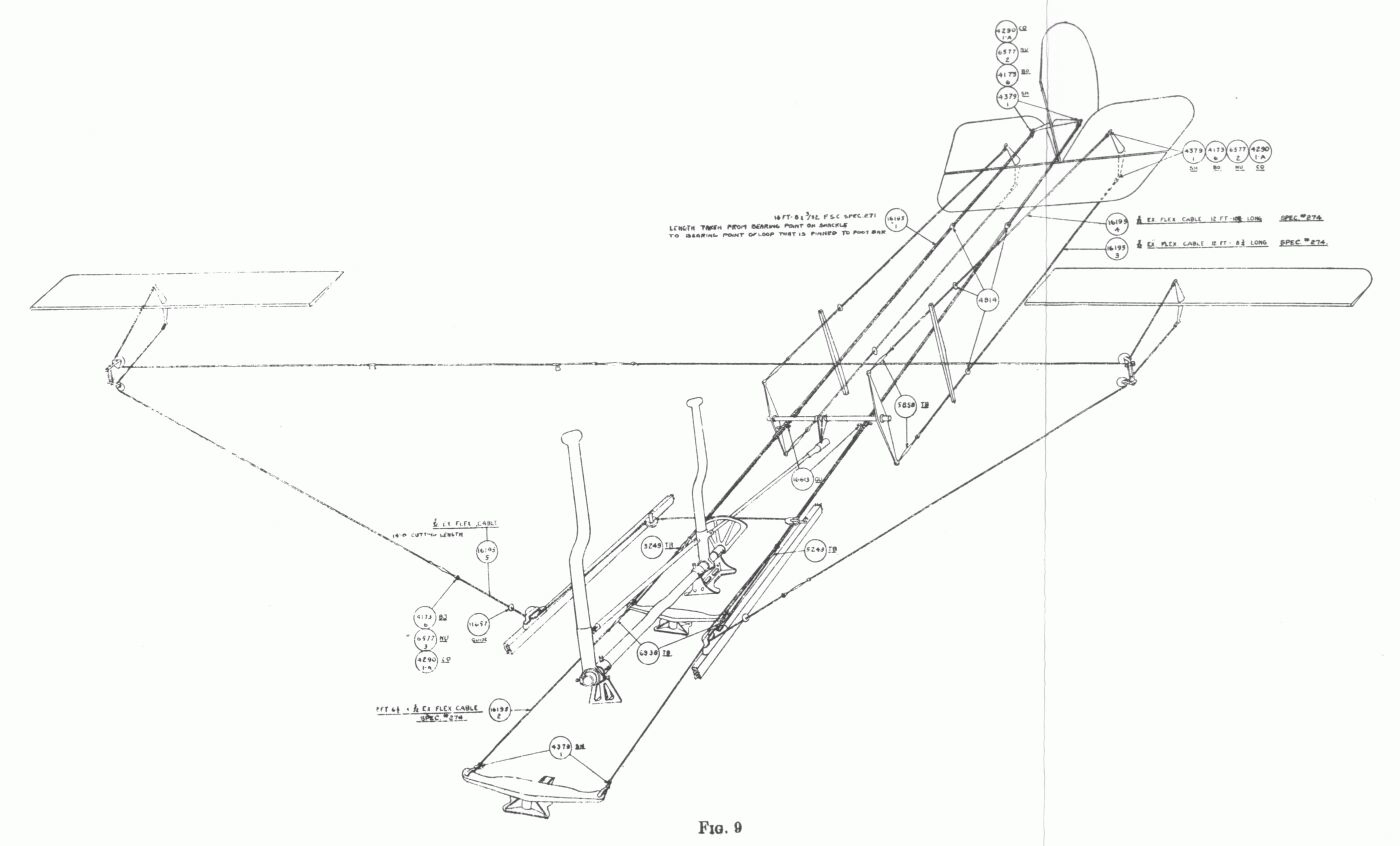
According to news reports, after the burning wreckage cooled, two pilots who witnessed the crash said they examined the wreckage and found a “long wrench” that had supposedly "slipped into the controlling gear" and jammed the plane's controls. This has become the accepted cause of the crash, but might need a reevaluation. Detailed diagrams from the Curtiss Standard N4-D Handbook of the control system don't show any “control gears”. The flight control is a system of rods, levers and wires linked to the control stick between the pilot's legs. The diagrams don't show any obvious location where a loose wrench could slide into the control system and get jammed. Since Wills had to make two stops because of engine trouble while flying the plane from Dallas, it may be more likely that engine trouble was the cause of the crash.
After their bodies were recovered, Coleman and Wills were taken to separate segregated funeral homes. Wills had a brother in Tallahassee, Florida who picked his body up the next day and transported it by train to Texas, where he was buried the following Monday.
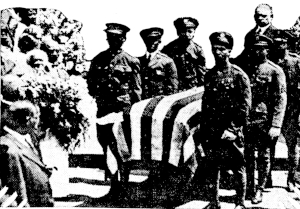
The May 1st event where Bessie Coleman was supposed to appear was canceled and the African-American community of Jacksonville went into mourning. A memorial service for Coleman was held on Sunday, May 2nd, attended by more than 5,000 people. Her body was then sent by train to Orlando, where another memorial service was held on Monday morning, and then put aboard another train to Chicago. Arriving on Wednesday morning, the casket was met by several thousand people and given a military escort by the African-American Eighth Infantry Regiment of the Illinois National Guard to a funeral home. An estimated 10,000 people viewed the casket over the next two days.
The funeral was held on Friday, May 7, 1925. Bessie Coleman's mother, Susan, her brother John – who had teased Coleman into learning to fly, and her sisters Elois, Nilus, and Georgia were joined at the service by 1,500 people inside the church, and 3,500 people outside. Six overseas veterans of the Eigth Regiment carried the casket. Ida B. Wells, civil rights activist and journalist, delivered one of the eulogies. Coleman was buried in Chicago's Lincoln Cemetery.
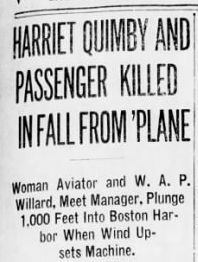
Today, in the 21st Century, it might seem insane for someone to fly in an open-cockpit plane and not strap in to a safety harness. But Bessie Coleman was part of the barnstorming era, when pilots performed extreme stunts like wing-walking and climbing from one plane to another to give audiences a thrill. It's understandable that they may not have thought about buckling up every time they flew, even though falling out of a plane was not a rare occurrence in the early 20th Century. Harriet Quimby, first American woman to earn a pilots license and to fly across the English Channel, who was probably an early inspiration for Bessie Coleman, died in an accident in 1912 when she and her passenger were both thrown from her plane. Other similar fatal incidents happened over the years leading up to Coleman's death. Barnstorming was inherently dangerous.
Twenty days after Bessie Coleman died, Congress passed the Air Commerce Act of 1926, a law intended to make aviation in the United States more efficient, reliable, and safer. By design, the Air Commerce Act effectively ended the barnstorming era. It gave the federal government the power to certify planes for airworthiness, and older planes like the Curtiss JN-4D had trouble passing inspections. The Commerce Department also passed regulations restricting how low stunt flying could be performed, making it hard for audiences to see. The expense and difficulty of complying with the new regulations, combined with the economic collapse of 1929 and the Great Depression that followed, drove most barnstormers out of business.
On January 6, 1928, World War I veteran Captain H. D. Meadows opened an aviation school in Chicago named for Bessie Coleman with 32 students enrolled. On Memorial Day, May 30, 1928, a small plaque was dedicated at Bessie Coleman's grave site. Over the following years, more and more African-Americans, men and women, began flying, and many cited Coleman as their inspiration. Among many honors, today we have a Bessie Coleman U.S. postage stamp and U.S. quarter. There is a Bessie Coleman Drive at Chicago's O'Hare International Airport, and a Bessie Coleman branch of the Chicago Public Library – Barack Obama read a Bessie Coleman story to kids there in 2025. While she never managed to start her own aviation school, Bessie Coleman's hope to be an inspiration has ultimately been realized.
Sources
(Click to open/close the list)
(Most newspaper sources accessed through Newspapers.com https://www.newspapers.com)
Rich, Doris L. Queen Bess: Daredevil Aviator
United States Census, 1880, National Archives and Records Administration
“Colored Aviatrix To Fly Here Soon”, Hartford Courant, Thu, Sep 29, 1921, pg. 2
“Experts In Aeronautics Agree That Los Angeles Meet ...” Los Angeles Evening Express, Sat, Jan 08, 1910
The Boston Globe, Sat, Sep 03, 1910 pg. 4
“World Famous Aviators Will Compete At The Belmont Park Meet”, The New York Times, Sun, Oct 16, 1910
“Aviator Alvin Longren Arrives In Waxahachie”, The Waxahachie Daily Light, Fri, Dec 8, 1911, Page 5
“An American Aviatrix Flies Across Channel”, The Waxahachie Daily Light, Tue, Apr 16, 1912, Page 1
“Negro Aviatrix Wants To Give Exhibition Here”, The Baltimore Sun, Wed, Nov 8, 1922, Page 14
“Miss Bessie Coleman Among the First to Clamp on “Flu” Lid”, The Chicago Defender, Sat, Nov 2, 1918
“Girl of 19 Flirts With Death Looping The Loop In Air”, The Gleaner, Mon, Jul 26, 1915
“Aviatrix Sets New World's Flight Record”, The Chicago Live Stock World, Mon, Nov 20, 1916, pg. 3
"Expert Flyers Here”, Chicago Tribune, Sun, Apr 15, 1917
“City To Get U.S. Aviation School Within Ten Days”, Chicago Tribune, Mon, Apr 16, 1917 pg. 3
“Combat Flying Exhibitions”, Chicago Tribune, Tue, Apr 29, 1919
“Alcock and Brown Fly Across Atlantic”, The New York Times, June 16, 1919 pg. 1
“With a wing clearance of only 15 feet”, New York Tribune, August 31, 1919 pg 4
“Battle Falcons in Sea To Sea Contest Today”, Chicago Tribune, Wed, Oct 8, 1919 Page 10
“First Negro Aviator”, The Brooklyn Daily Times, Thu, Jan 11, 1912 pg. 4
“Chicago's Newest Inventor”, The Chicago Defender, Sat, May 12, 1917 Page 1
Lloyd, Craig, Eugene Bullard, Black Expatriate In Jazz-Age Paris
“Recalls Exploits Of Brave Bessie Coleman on 10th Anniversary Of Tragedy”, The Chicago Defender, Sat, May 2, 1936, Page 22
“Chicago Colored Girl Learns To Fly Abroad”, New York Tribune, Mon, Sep 26, 1921
“Chicago Girl Is A Full-Fledged Aviatrix Now”, The Chicago Defender, Sat, Oct 1, 1921 Page 1
“Aviatrix Must Sign Away Life To Learn Trade”, The Chicago Defender, Sat, Oct 8, 1921, Page 2
“Famed Aviatrix Visits Holland On Trip Abroad”, The Northwestern Bulletin-Appeal, Sat, May 27, 1922
“Negro Aviatrix Arrives”, The Burlington Free Press, Tue, Aug 15, 1922 pg 3
“Bessie To Fly Over Gotham”, The Chicago Defender, Sat, Aug 26, 1922 pg 1
“Bessie Gets Away; Does Her Stuff”, The Chicago Defender, Sat, Sep 9, 1922
“Colored Aviatrix In Successful Try”, The Black Dispatch, Thu, Sep 21, 1922
“Miss Coleman Gives Flying Exhibition”, The Afro-American, Fri, Sep 15, 1922
“Bessie Gives Lecture On Aviation”, The Chicago Whip, Sat, Oct 7, 1922, Page 3
“Negro Children To Attend Fair Today”, The Commercial Appeal, Fri, Oct 13, 1922
“Bessie Coleman Makes Initial Aerial Flight”, The Chicago Defender, Sat, Oct 21, 1922, Page 3
“Queen Bess To Try Air October 15”, The Colorado Statesman, Sat, Oct 14, 1922
“Bessie Colemand To Star In A Seminole Super Film”, The Afro-American, Fri, Oct 20, 1922
'Bird Woman Here”, The Afro-American, Fri, Nov 10, 1922
“Bessie Coleman Breaks Contract”, The Afro-American, Fri, Dec 1, 1922
“Passing Aviators “Drop In” From Sky For Night's Stay”, Press-Telegram, Sun, Jan 28, 1923, Page 37
“Only Negro Aviatrix Lands Here; Chinese Flyer Also”, The Long Beach Telegram and The Long Beach Daily News, Sun, Jan 28, 1923
“Birdwoman Is Coast Dealer”, The Oakland Post Enquirer, Fri, Jan 12, 1923
“Colored Girl Flier Plans New School”, The San Francisco Call Bulletin, Tue, Jan 16, 1923
“Only Colored Aviatrix In The World Is A Los Angeles Visitor”, California Eagle, Sat, Jan 27, 1923
“Female Flyer Has A Record”, The Los Angeles Times, Sun, Jan 28, 1923
“Woman Hurt In Dive Of Airplane In Santa Monica”, Evening Vanguard, Mon, Feb 5, 1923
“Flies All Over Europe”, California Eagle, Sat, Feb 10, 1923
“Airplane Used For Ad Work”, The San Francisco Examiner, Sun, Feb 18, 1923
“Airplane Use By Advertiser For The Coast Tire Company”, The Sacramento Union, Sun, Mar 11, 1923
“Other Race Appreciates Girl Flyer”, California Eagle, Sun, Mar 4, 1923
“Bessie Coleman To Appear In Movies”, California Eagle, Sat, May 5, 1923
“Noted Aviatrix Flits Eastward”, California Eagle, Sat, Jun 23, 1923
“No Flight By Bessie Coleman; Rain Interferes”, The Chicago Defender, Sat, Sep 8, 1923, Page 2
“Plans Flight”, The Chicago Defender, Sat, Sep 22, 1923
“Bessie Coleman, the only colored girl aviatrix...”, The Chicago Defender, Sat, Feb 2, 1924
“Bessie Coleman opened ther Lincoln Theater”, The Chicago Defender, Sat, Apr 5, 1924
“Bessie Coleman, aviatrix, appearing in person ...”, The Chicago Defender Sat, Apr 12, 1924
“Aviatrix Loses Another Manager”, The Afro-American, Fri, May 2, 1924 Page 4
“Motion Picture News”, The Chicago Defender, Sat, May 10, 1924, Page 8
“Bessie Banned”, The Chicago Defender, Sat, May 24, 1924
“Texas Negro Girl Becomes Able Aviatrix”, The Houston Post, Thu, May 7, 1925, Page 4
“Flying Circus Is Main Event On Juneteenth”, The Houston Post, Thu, Jun 18, 1925, Page 2
“Negroes Prepare For Juneteenth”, The Houston Post, Fri, Jun 19, 1925
“Negro Aviatrix Thrills Throng”, The Houston Post, Sat, Jun 20, 1925
“Bessie Coleman, only negro air pilot ...”, The Houston Chronicle, Sun, Jul 5, 1925
“Negress Will Give Aerial Exhibit Here”, The News, Sat, Jul 18, 1925
“Negress To Give Aerial Exhibition”, San Antonio Express-News, Sun, Jul 19, 1925
“Only Negro Aviatrix To Fly Here August 9”, San Antonio Light, Mon, Jul 20, 1925
“Negress To Give Flight Exhibition”, The Los Angeles Times, Mon, Jul 27, 1925
“S.A. Negro Girl To Try Parachute Leap”, The News, Sat, Aug 8, 1925
“Only Negro Aviatrix To Fly Here August 9”, San Antonio Light, Sun, Aug 9, 1925, Page 16
“Negress Will Give Aerial Exhibit Here”, The News, Mon, Aug 10, 1925
“Governoer “Ma” Ferguson Greets Bessie Coleman”, The Chicago Defender, Sat, Aug 15, 1925
“Aviatrix Plans Farewell Flight”, The Houston Post, Sun, Jul 5, 1925
“Negro Woman To Make Farewell Flights Sunday”, The Houston Chronicle, Fri, Jul 10, 1925
“Texas Negro Girl To Stage Flying Circus”, The Houston Post, Sat, Jul 11, 1925
“Bessie Coleman Flies In Houston”, The Afro-American, Sat, Jul 11, 1925
“Aviatrix Heads Another Meet”, The Afro-American, Sat, Jul 18, 1925
“Aviatrix Performs For Texas Crowds”, The Chicago Defender, Sat, Jul 25, 1925
“Wharton Gives Negro Aviatrix New Airplane”, The Houston Post, Wed, Sep 9, 1925, Page 11
“Bessie Coleman, Negro, To Fly Here Saturday”, The Waxahachie Daily Light, Fri, Sep 25, 1925, Page 5
“Negro Aviatrix To Fly Here Today”, Fort Worth Star-Telegram, Sun, Oct 11, 1925
“Daring Colored Female Aviatrix”, The Savannah Tribune, Jan 7, 1926
“Bessie Coleman In Georgia”, The Afro-American, Sat, Jan 16, 1926
“Bessie Coleman”, The Chicago Defender, Sat, Jan 9, 1926
“Bessie Coleman”, The Chicago Defender, Sat, Jan 30, 1926
“Floral, Musical Fete In Orlando”, Jacksonville Journal, Tue, Mar 9, 1926
“Festival In Orlando Will Start Today”, The Florida Times-Union, Tue, Mar 9, 1926 Page 6
“Colored Woman Will Fly In Jax”, Jacksonville Journal, Wed, Apr 28, 1926
“Jax Airplane Crash Kills Two”, Jacksonville Journal, Fri, Apr 30, 1926
“Negro Aviatrix and Texan Killed When Airplane Falls”, The Atlanta Journal, Fri, Apr 30, 1926
“5,000 Persons At Funeral of Bessie Coleman, Aviatrix”, New Journal and Guide, Sat, May 8, 1926
“Bird-Woman Falls 2000 Feet To Death”, The Afro-American Sat, May 8, 1926 Pg. 1
“Funeral of Aviatrix”, The Afro-American, Sat, May 15, 1926
“Only Known Woman Aviator Of Color Instantly Killed”, The Monitor, Fri, May 7, 1926
“Negro Aviatrix's Funeral Attended By Large Crowd”, The Orlando Sentinel, Fri, May 7, 1926
“Bessie Coleman, The Colored Aviatrix, Killed In Long Fall”, The New York Age, Sat, May 8, 1926
“Amateur Aviator Dead”, San Angelo Evening Standard, Tue, Jun 16, 1925 pg 6
“Aviator Dies, Loosens Strap To Peer Over Side, Falls”, The Buffalo Times, Sun, Sep 13, 1925 pg 38
"Air Commerce Act of 1926, Chapter 344", Statutes At Large Of The United States of America, 1925-1927, pg. 569
“The Air Commerce Act of 1926”, Columbia Law Review , Dec., 1927, Vol. 27, No. 8, pp. 989-996
The First U.S. Federal Pilot License, United States Federal Aviation Administration, FAA Milestones and Events, https://www.faa.gov/sites/faa.gov/files/about/history/milestones/first_pilots_license.pdf
Books: (The Native History Association is an Amazon Associate. If you buy using one of our Amazon Book links, we get a small percentage of the sale, and we appreciate that support.)